Showing posts with label gempabumi. Show all posts

Tuesday, 9 June 2015

Quake dashes wedding hopes of Mountain Torq staff

Joannes (left) and a relative, Felix, being interviewed after leaving the mortuary.

KOTA KINABALU: Mountain Torq staff Valerian Joannes, 27, was supposed to get married in November this year.

However, the earthquake in Ranau took him away from his fiancée and family.

Valerian, the fourth child among 10 siblings, was one of the staff who accompanied the Singaporean students on their excursion to Mount Kinabalu. His father, Joannes Lubak, 50, said his son had assured his colleague of his safety after the first tremor through walkie talkie, and he was rescuing the children.

But after that, Valerian was unreachable.

Joannes said this in an interview after leaving the Queen Elizabeth Hospital (QEH) mortuary here on Sunday.

Joannes was at Muar in Johor when he received the news of his son’s death, and till now, he still could not accept the
reality.

“His mother was devastated with the sudden passing of Valerian,” he said, adding that he received a call from the hospital about his son on Saturday night.

Joannes last saw Valerian at a family gathering on May 30 and he had reminded his son to be careful in his work.

Valerian’s body would be brought back to his village at Kampung Bundu Tuhan for burial.

Meanwhile, the body of five Singaporeans were flown back to the country in a Singapore Air Force plane on Sunday, including the body of 12-year-old Wee Ying Peony.

Wee was among the 29 pupils and eight teachers from the primary school who went on an overseas school trip to Mount Kinabalu.

Meanwhile, The Malaysian Association of Tour and Travel Agents (MATTA) vice president for inbound, Datuk Tan Kok Liang, also visited the families of victims at QEH yesterday afternoon to offer his condolences.

“Our heartfelt condolences to the families of the victims.

“May God grant them peace and comfort as they go through this period of bereavement and sadness,” he said.

- Source: The Borneo Post 

FB pendaki bogel diserang ayat "Mak kau hijau"

Istilah "Mak kau hijau" digunakan netizen untuk serang laman Facebook Emil. - Foto Facebook

KUALA LUMPUR: Dua hari lepas, tersebar sebuah video pergaduhan yang membabitkan dua orang budak lelaki di sebuah taman perumahan. Apa yang viral tentang video tersebut adalah penggunaan kata "Mak kau hijau" yang digunakan.

Ayat tersebut didefinisikan sebagai satu bentuk kata-kata kesat. Entah bagaimana dan dari mana kata-kata sebegitu boleh muncul. Maklum sahaja, tengah bergaduh dan dalam keadaan marah.

Namun apa yang menggelikan hati, istilah itu kini ditujukan pula kepada salah seorang pendaki Gunung Kinabalu yang berbogel, Emil Kaminski.


Ayat itu antara yang popular digunakan netizen yang menyerang laman Facebook milik Emil, apatah lagi selepas Emil memuat naik sebuah video kontroversi berjudul Trolling Malaysia.

Di laman Youtube, video itu menerima 92 likes dan 649 dislikes, dengan jumlah tontonan 14,309.

- Sumber: Astro Awani 

Monday, 8 June 2015

Bomba nafi anggota seret mayat di Gunung Kinabalu‎

Gambar yang diviralkan di laman sosial.

SHAH ALAM – Jabatan Bomba dan Penyelamat Malaysia (JBPM) menafikan sekerasnya penyebaran sekeping gambar menunjukkan salah seorang anggotanya yang terlibat dalam operasi mencari dan menyelamat (SAR) menyeret mayat pendaki Gunung Kinabalu.

Perkara itu disahkan oleh JBPM melalui akaun Facebooknya hari ini sambil menegaskan ia tidak pernah berlaku seperti dalam gambar tersebut yang kini menjadi viral dalam laman sosial.

“Kami pasukan penyelamat di Malaysia sedang bertungkus-lumus dan bertarung nyawa untuk menyelesaikan amanat yang digalas oleh pihak kami.

“Tidak berlaku apa yang digambarkan itu, sebaliknya anggota penyelamat sedang menunggu rakan penyelamat lain untuk mengangkat bersama,” kata agensi kerajaan itu dalam satu kenyataan, hari ini.

Terdahulu gambar tersebut menjadi viral apabila aksi seorang anggota penyelamat bomba yang dirakam dilihat seolah-olah menyeret seorang mayat pendaki Gunung Kinabalu ke sebuah helikopter dalam usaha menyelamat mangsa gempa bumi itu, kelmarin.

Gambar tersebut dipercayai disebarkan oleh sebuah blog beautyfulnaraa2u yang berkongsi pelbagai rakaman gambar termasuk mangsa gempa bumi di kaki Gunung Kinabalu dan pasukan penyelamat yang bertugas.

- Sumber: Sinar Harian 

Sabah quake: Confirmed death toll now 16

If climbing Mt Kinabalu is considered challenging, just imagine the task of bringing down dead bodies among falling debris. — Photo courtesy of Search and Rescue team

KUNDASANG, Ranau: The Search and Rescue (SAR) team combing the slope of Mount Kinabalu for survivors or bodies of climbers caught in the rock fall triggered by the earthquake last Friday morning recovered five more remains of the victims yesterday.

This brought the total number of confirmed deaths in the tragedy to 16 with two climbers still listed as missing.

This was disclosed to the press by Tourism, Culture and Environment Minister Datuk Seri Panglima Masidi Manjun at a press conference at the operation centre yesterday.
Nordin (third right) briefing his men before they are airlifted to Mt Kinabalu to continue their search and rescue.

The team also found parts of two bodies that were so badly mangled by the falling rocks that it was impossible to make any positive identification.

“What the team found were body parts and until we can identify if they were of the two missing Singaporeans or part of the earlier finds, we will categorised them as still missing,” he said.

He said those confirmed dead so far were six Malaysians, seven Singaporeans, a Japanese, a China national and a Filipino while the two still listed as missing were a Singaporean teacher and her student. Amidst the gloom at the operation centre, Masidi announced a rare piece of good news that one of the climbers thought to be missing had actually gone back to Kuala Lumpur.

Mohd Khairuladzuan Abd Khalif, 39, had descended the mountain with the first group of 52 climbers but was not registered with the operation centre, Masidi said.

Nordin despatching teams to Mt Kinabalu to continue looking for remaining missing climbers.

The minister said the SAR operation would be scaled down because aside from the two listed as still missing and the 16 bodies found so far, all the climbers and guides had been accounted for.

“Until we find the two still categorized as missing, we will continue with the operation. If needed, we will stay on and do all we can until everyone has been accounted for,” the Karanaan assemblyman stressed.

Masidi said that initial investigation showed that the worse hit area was at the Via Ferrata route.

When pressed by the foreign media for confirmation of the Japanese climber’s identity, Masidi said that as a matter of policy it was better to inform the family of the deceased first.

“I understand your profession you need to outdo one another to get the latest information but your responsibility is to your editors but my responsibility is to the family. I would like to believe that I will break the news to them in a more dignified manner. I hope you understand sometimes there are things that we cannot tell you simply because it is out of respect for the next of kin,” he said.

It was a daunting task to locate those Mount Kinabalu climbers who were stranded following Friday’s earthquake. Here, search and rescue team personnel and mountain guides working together to bring down the remains to give closure to the victims’ families. – Photo courtesy of search and rescue team

Meanwhile the Bomba Chief here, Nordin Pauzi, explained that it was impossible to bring many rescuers up the mountain for the search mission because of the limited sitting capacity of the helicopters which could only carry 6-8 passengers.

“Our objective is to send rescuers in the morning to find the remaining victims. And by afternoon, we hope to be able to evacuate all of them,” Nordin told the media at Kundasang open field near its bazaar.

Nordin added that all the bodies found had been transported to various hospitals such as Queen Elizabeth Hospital in Kota Kinabalu and Ranau Hospital.

On the criticism of SAR’s effort in rescuing the victims compared to the praises sung on the mountain guides, Nordin said he understood that the people’s frustration.

“When the incident occurred, the mountain guides were with them and it was their duties to help the climbers. And while that happened, we were still all over at different camp sites.

“Before we came in, the whole evacuation process was in havoc. Only when we arrived did that the rescue process became systematic.”

On the reports that supplies and aid dropped by the helicopter fell off the cliff Nordin said the pilots tried to drop the supplies and aid as near to the rescuers as possible. Most times, around the area, there was no flat open space. Then there was also the factor of strong wind. The pilots tried their best to drop as near to the rescuers as possible.

“I believe the comments in the social media had not been very fair to us. But we are not particularly perturbed by it because our main task is to accomplish our mission,” Nordin asserted.

Since early yesterday morning, SAR has dispatched four teams in four separate trips to Mt Kinabalu.


- Source: The Borneo Post | June 8, 2015, Monday

Sunday, 7 June 2015

7 things you should know about the Ranau earthquake

Strong tremors in Ranau will continue to be felt especially when the stored energy exceeds the Earth's ability to store it, said an expert.

KUALA LUMPUR: A 6.0-magnitude earthquake rocked Sabah early Friday and it has been cited by Bernama as the strongest to hit the state since 1991.

The US Geological Survey said the quake struck at a depth of 10 kilometres, with its epicentre located 19 kilometres (12 miles) from the town of Ranau and 54 kilometres from Kota Kinabalu.

Malaysia does experience earthquakes but is outside the Ring of Fire, a belt of seismic activity running around the basin of the Pacific Ocean that includes neighbours Indonesia and the Philippines.

In a WhatsApp session with Prof Felix Tongkul, Universiti Malaysia Sabah’s Professor of School of Geology and also a geologist, he provided insights into this natural disaster.


Q1: How was it that Ranau had been struck by a 6.0-magnitude earthquake?

A: When it comes to the Ranau earthquake, it was caused by the presence of active fault lines.

This is because Sabah is still receiving compression forces from the interaction of three main tectonic plates.

Sabah is actually located on the southeastern Eurasian Plate which is bordered by the Philippine Plate and the Pacific Plate.

The Philippine Plate and Pacific Plate are moving westwards at a rate of about 10cm a year, colliding with the Eurasian Plate.

Additionally, the southern part of the Australian plate is moving northwards at a speed of 7cm per year, and this plate boundary is the most active and unstable. Although Sabah is 1,000km away from the collision of the plates, it still can experience the compression force.

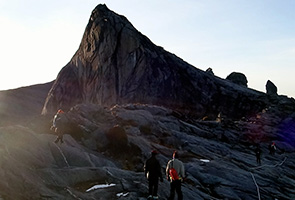
A large avalanche of earth and rock on Mt Kinabalu following a 6.0-magnitude earthquake which struck Sabah on Friday. Some 137 climbers were trapped on the mountain
after the quake hit.

Q2: Do the moving plates affect areas on the Peninsular?

A: Sabah is the closest part of Malaysia to the Philippines and Sulawesi in Indonesia thus, it will experience more compression force than Sarawak and Peninsular Malaysia.

Q3: More than 30 aftershocks were recorded by the Meteorological Department following the earthquake on Friday. How long will this continue?

A: The aftershocks are smaller tremors that occur while the Earth’s crust settles. Usually the aftershocks will continue up to two to three weeks.

Sometimes, smaller tremors can occur before the strong quake hits, and this is called Foreshocks. Foreshocks are relatively smaller earthquakes that precede a larger earthquake.

Q4: The people have become afraid after the quake struck and they fear that Mount Kinabalu will erupt in the near future. Will it erupt?

A: What occurred in Ranau is not linked to volcanism, which is only possible in Tawau and Semporna, where an explosion occurred several hundred years ago. Volcano craters are still visible in Tawau.

Mount Kinabalu will not erupt, as the igneous intrusion that formed Mount Kinabalu is caused by the compression of the three Plates mentioned previously.

An injured child being attended to by search and rescue personnel before being brought
to the Ranau Hospital.

Q5: Is there a possibility that Sabah will be struck by another strong tremor like the one on Friday?

A: Strong tremors in Ranau will continue to occur whenever the stored energy exceeds the Earth’s ability to store it. This happens on a regular basis.

In the case of Ranau, it happens at an approximate rate of every 25 years, with the first being recorded in 1966 measuring 5.3 on the Richter scale.

This was followed with a 5.2-magnitude earthquake in 1991.


Q6: What causes an earthquake?

A: Earthquake tremors are the result of a rapid release of energy where seismic waves move in all directions from the source, known as a focus.

A point on the Earth's surface above the focus is called the earthquake centre. For example, the centre of the Ranau earthquake is near the peak of Mount Kinabalu.

This means the focus of the earthquake was underneath its centre; in this case it was 10km below the centre. This is what caused the massive landslides.

Tremors usually occur along faults, or longitudinal cracks in the earth that have bent and snapped back in what is called an elastic rebound.

Imagine taking a plastic ruler and bending it. After a certain point it will break and release all the energy put into it from our effort to bend it. When an earthquake happens, the rocks in the earth are behaving in a similar fashion.


Mt Kinabalu guides carrying down an injured child following a 6.0-magnitude earthquake that struck Sabah on Friday. 

Q7: Then what’s the meaning of Seismic?

A: Seismic waves refer to the energy that is released after an earthquake during the elastic rebound. There are three types of seismic waves – primary, secondary shear waves and surface waves.

Primary waves are the fastest and move forward and backwards like a lurching car. This can cause dizziness, as surface waves are also moving from left to right. All three waves can be felt almost at once if one is close to the earthquake’s centre.

About 80% of earthquakes occur in the Pacific Rim due to a collision of tectonic plates in the Earth’s crust. The rest occur outside those regions in areas with active fault lines. 

- Source: Astro Awani